
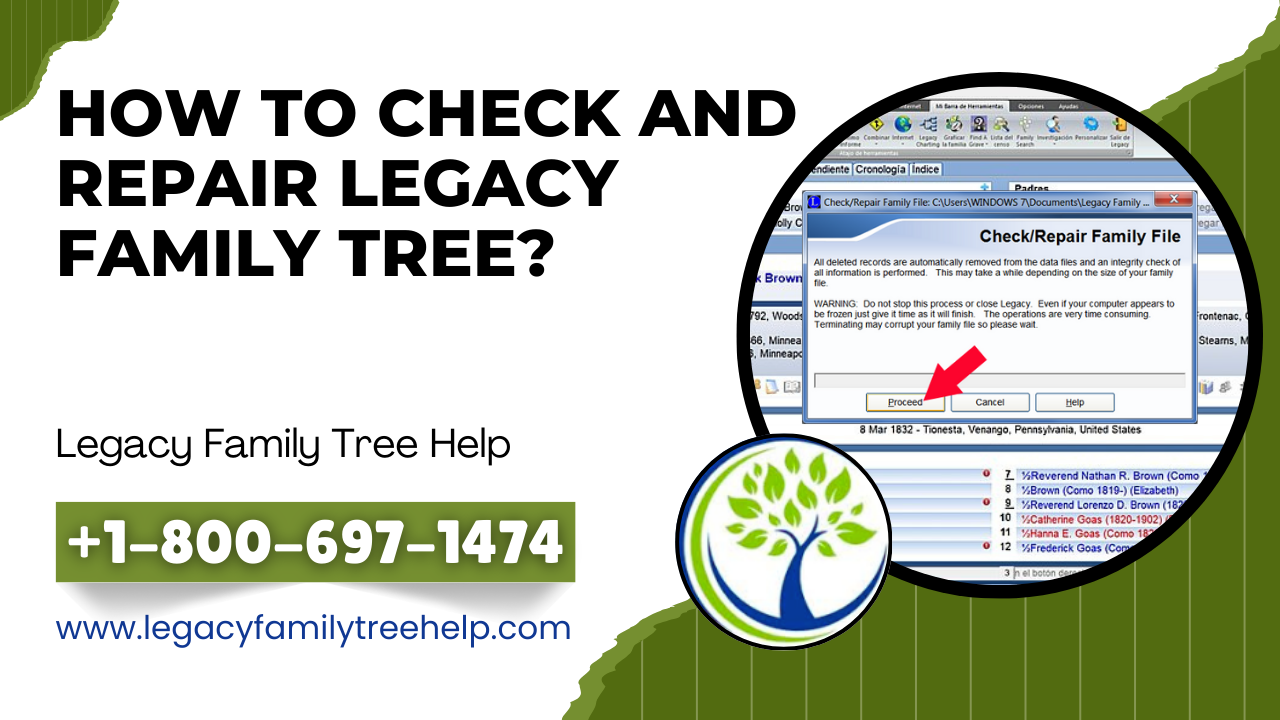
Legacy Family Tree is one of the most popular genealogy software programs used by family historians to organize, manage, and preserve family history records. Over time, database errors, broken links, unexpected shutdowns, or file corruption can affect the performance of your family tree file. That is why it is important to regularly check and repair Legacy Family Tree files.
In this guide, you will learn how to use the Check and Repair feature in Legacy Family Tree, when to run it, and how it helps maintain the health of your genealogy database.
What Is the Check and Repair Feature in Legacy Family Tree?
The Check and Repair tool is a built-in maintenance utility in Legacy Family Tree that scans your family tree database for errors and automatically repairs common issues.
This feature helps:
- Detect database inconsistencies
- Repair broken family links
- Fix relationship errors
- Improve database performance
- Prevent future file corruption
- Maintain genealogy data accuracy
Running this tool regularly is considered one of the best practices for Legacy Family Tree maintenance.
Why Should You Check and Repair Legacy Family Tree Files?
Just as you perform regular maintenance on your vehicle, your genealogy database also requires routine maintenance.
You should run Check and Repair before:
- Upgrading to a newer version of Legacy Family Tree
- Installing software updates
- Importing GEDCOM files
- Merging duplicate individuals
- Renumbering RINs
- Performing large database changes
- Creating backups
- Restoring family tree files
Regular maintenance can help prevent unexpected database issues and data corruption.
How to Check and Repair a Legacy Family Tree File
Follow these steps carefully:
Step 1: Open Legacy Family Tree
Launch Legacy Family Tree on your Windows computer.
Step 2: Open File Maintenance
Click on:
File Menu → File Maintenance → Check/Repair
Step 3: Start the Check and Repair Process
After opening the utility:
- Click the Proceed button on the first screen.
- Click Proceed again on the second screen.
The software will begin scanning your database.
Step 4: Allow the Process to Complete
Legacy Family Tree performs more than 190 internal database checks.
Important:
- Do not interrupt the process.
- Do not close the software during the scan.
- Allow all repair operations to finish completely.
Step 5: Review Error Messages
If error messages appear during the repair process:
- Click No when prompted to complete the repair process.
- In some situations, Legacy may request confirmation and you may need to click Yes.
Follow the on-screen instructions carefully.
Step 6: Check the Error Log
When the process finishes, Legacy Family Tree may generate an Error Log.
If an Error Log appears:
- Close the log.
- Run the Check/Repair process again.
In many cases, the second scan automatically resolves remaining issues.
Step 7: Manually Fix Remaining Errors
If the Error Log is generated again after the second scan, manual corrections may be required.
Common issues include:
- Husband and wife gender assignments reversed
- Incorrect parent-child relationships
- Individuals linked as their own parent
- Duplicate family relationships
- Invalid record links
Review the Error Log carefully and correct the affected records manually.
Common Legacy Family Tree File Errors
Some common database issues include:
- Corrupted family tree records
- Missing relationships
- Duplicate individuals
- Broken media links
- Invalid parent-child connections
- GEDCOM import errors
- Database indexing issues
Regular use of Check and Repair helps identify and resolve many of these problems before they become serious.
Best Practices Before Running Check and Repair
Before performing maintenance, always:
- Create a full backup of your family tree file
- Backup media files and photographs
- Close unnecessary applications
- Verify sufficient disk space
- Save all recent genealogy research
A current backup provides protection in case unexpected issues occur.
Frequently Asked Questions
How often should I run Check and Repair in Legacy Family Tree?
Most genealogy experts recommend running Check and Repair before major updates, imports, merges, and database modifications.
Can Check and Repair fix corrupted family tree files?
The utility can repair many common database issues. However, severe corruption may require restoring a backup.
Will Check and Repair delete my genealogy records?
No. The tool is designed to repair database structures without removing valid genealogy data.
Should I create a backup before running Check and Repair?
Yes. Creating a backup before any major database maintenance task is highly recommended.
Does Check and Repair improve software performance?
Yes. Removing database inconsistencies often improves overall performance and stability.
Conclusion
The Check and Repair feature is one of the most important maintenance tools available in Legacy Family Tree. Regularly running this utility helps prevent file corruption, repair relationship errors, improve database performance, and maintain the accuracy of your genealogy research.
If you are experiencing database errors, file corruption issues, missing family relationships, or other Legacy Family Tree problems, running Check and Repair should be one of the first troubleshooting steps you perform.
Need Help with Legacy Family Tree?
If you need assistance with Legacy Family Tree file repair, database recovery, software installation, backup restoration, or genealogy troubleshooting, our independent support specialists are available to help.
📞 Call: +1-800-697-1474
Disclaimer: We are an independent third-party support provider and are not affiliated with or endorsed by Legacy Family Tree or its developers. All trademarks belong to their respective owners.